
 当前位置:
当前位置:Wave Function Engineering in Core/Shell Quantum Dots for Efficient Single and Multiexciton Dissociation
SEMINAR
The State Key Lab of
High Performance Ceramics and Superfine Microstructure
Shanghai Institute of Ceramics, Chinese Academy of Sciences
中国科学院上海硅酸盐研究所高性能陶瓷和超微结构国家重点实验室
Wave Function Engineering in Core/Shell Quantum Dots for Efficient Single and Multiexciton Dissociation
Speaker
Dr. Tianquan (Tim) Lian
Department of Chemistry, Emory University
Atlanta GA 30322
时间:5月26日 (星期四)上午10:00
地点:2号楼607会议室
联系人:陈立东研究员 张文清研究员
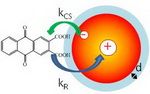 Abstract. Charge transfer to and from quantum dots (QDs) is of intense interest because of its important roles in QD-based devices, such as solar cells and light emitting diodes. Recent reports of multiple exciton generation (MEG) by one absorbed photon in some QDsoffer an exciting new approach to improve the efficiency of QD-based solar cells and to design novel multi-electron/hole photocatalysts. However, two main challenges remain. First, the efficiency of MEG process remains controversial and may need to be significantly improved for practical applications. Second, the utilizatoin of the MEG process requires ultrafast exciton dissociation prior to the exciton-exciton annihilation process, which occurs on the 10s to 100s ps time scale. In this presentation we report a series of studies of exciton dissociation dynamics in quantum dots by electron transfer to adsorbed electron acceptors. We showed that excitons in CdSe could be dissociated on the a few picosecond timescale to various adsorbates. As a proof of principle, we demonstrated that multiple excitons (generated by multiple photons) per QD can be dissociated by electron transfer to adsorbed acceptors. We will discuss the dependence of these rates on the size and the nature of the quantum dots and the approaches for optimizing single and multiple exciton dissociation efficiencies by wave-function engineering in QD heterostructures.
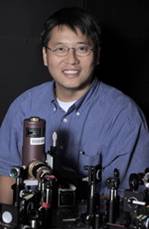 Biographical sketch.Dr. Tianquan Lian received his BS degree from Xiamen University in 1985 and MS degree from the Chinese Academy of Sciences in 1988. He began his PhD study in 1988 under the supervision of Prof. Robin Hochstrasser at the department of Chemistry, University of Pennsylvania, where he received his PhD degree in December, 1993. After postdoctoral training with Prof. Charles B. Harris in the University of California at Berkeley, Tim Lian joined the faculty of chemistry department at Emory University in 1996. He was promoted to associate professor in 2002, full professor in 2005, Winship distinguished research professor of Chemistry in 2007, and William Henry Emerson Professor in 2008. Tim Lian is a recipient of the NSF CAREER award and the Alfred P. Sloan fellowship. Tim Lian research interest is focused on ultrafast dynamics in photovoltaic and photocatalytic nanomaterials and at their interfaces.